
З усіх утрат втрата часу найтяжча
Of all losses, the loss of time is the hardest one.
Gregory Skovoroda, Ukrainian Philosopher (1722-1794)
Breathe. Just breathe. Hands out. Smile.
Juliana runs, arms outstretched, as she leads the ensemble in the Hopak. Every step is controlled with fluidity, thanks to the sapyansti on her feet. As she traverses the stage, sheets of music treble with ferocious passion for the song and dance. All her joy held inside those sturdy red leather boots. The crowd stands to cheer, their Vyshyvanka blending together like a woven tapestry, its length spanning a collective history of more than 1,000 years.
Toe—heel—lift—kick. Dribushka.
A spirit lingers in the air. It knows them by their smell, flesh, and blood that sings a love for their ancestral home, a fermata that transcends generations. It is a spirit of pride that burns brazenly like the Firebird, feeding off the crowd’s fervor, clawing its way through every smile as crow’s feet wrinkle in the corners of their eyes.
Toe—heel—lift—kick.
The troupe dances and spins until they release from one another in a single breath, like dandelion seeds floating away with the wind. Some of the men explode into high leaps while others roam across the stage in squatting kicks. Their blue satin pants encroach like cornflowers on a poppy field as the women link arms, their sleeves stitched in geometric patterns of red. Quickly they tiptoe forward in semi-quavers, their heads leaning side to side like the pendulum of a metronome. Their faces gleam as they look out into the audience singing their praises, some of whom are dancing along in the aisles. Juliana scans the crowd in search of her own family. Mama and Tato are there, beaming with pride as they watch their daughter of nineteen years carry on their favorite tradition.
Tradition; the thing that bound all of them together on nights like this. Outside the concert hall, across the city, glossy braids of kolach cradle candles on dining room tables. Sheafs crafted into Didukhy are positioned in places of honor to hold space for the ancestors. Families set out plates of boiled wheat, honey, borscht, dumplings, stuffed cabbage, and stewed fruit. Plates caper across tables like a choreographed meatless feast with the hope for all present will enjoy a prosperous new year. Most notably, at every table there is an empty chair, a place setting that sits in silence. A reminder for the living their dead are always near and welcome to partake in the festivities of Svyata Vecheria.
Juliana breaks into a pirouette, her skirt fanning into a swirling floral burst. Faster, faster she spins, never breaking her enthusiasm, always smiling out into the dark. She is illuminated by a spotlight following her across the stage. Ribbons attached to the efflorescent wreath on top of her head whip and curl, obscuring her view, veiling the world in streams of color until she slows down and the audience fades away, their claps muffled in her ears. The ensemble members meet into a singular line, lift their hands high, and take a bow as the concert hall roars.
Luminescent twinkling splashes the auditorium’s walls and spills out into the streets of Kherson as a parade of paper-mache stars bob up and down in merry. Juliana is mesmerized. She waves goodbye to her fellow performers and wanders onward toward the trill of a trembita as it urges her to follow the familiarity of the kolyadki. The beating pulse of drums grows as she nears the throng of carolers carrying their hand-crafted stars. Snow falls in thick clumps from the sky, and she realizes she did not bring her coat. It matters not; the cold only gently nips her skin through her apron.
The calm of the broad gray sky turns dark and opaque. Lanterns guide the masses past towering baroque and classicist buildings. Past places of importance like the Maritime Academy and St. Catherine’s Cathedral, its bed of roses sleeping soundly under the white blanket of winter.
This city upon the Dnipro River is the foundation for Juliana’s entire being. It is where her Tato learned to be a shipwright, providing a way to build a life for their family. It is where Juliana learned her love of art and culture in the hallowed halls of places like the Mykola Kulish Theatre. It is where Mama taught her first steps in the art of Ukrainian folk dance.
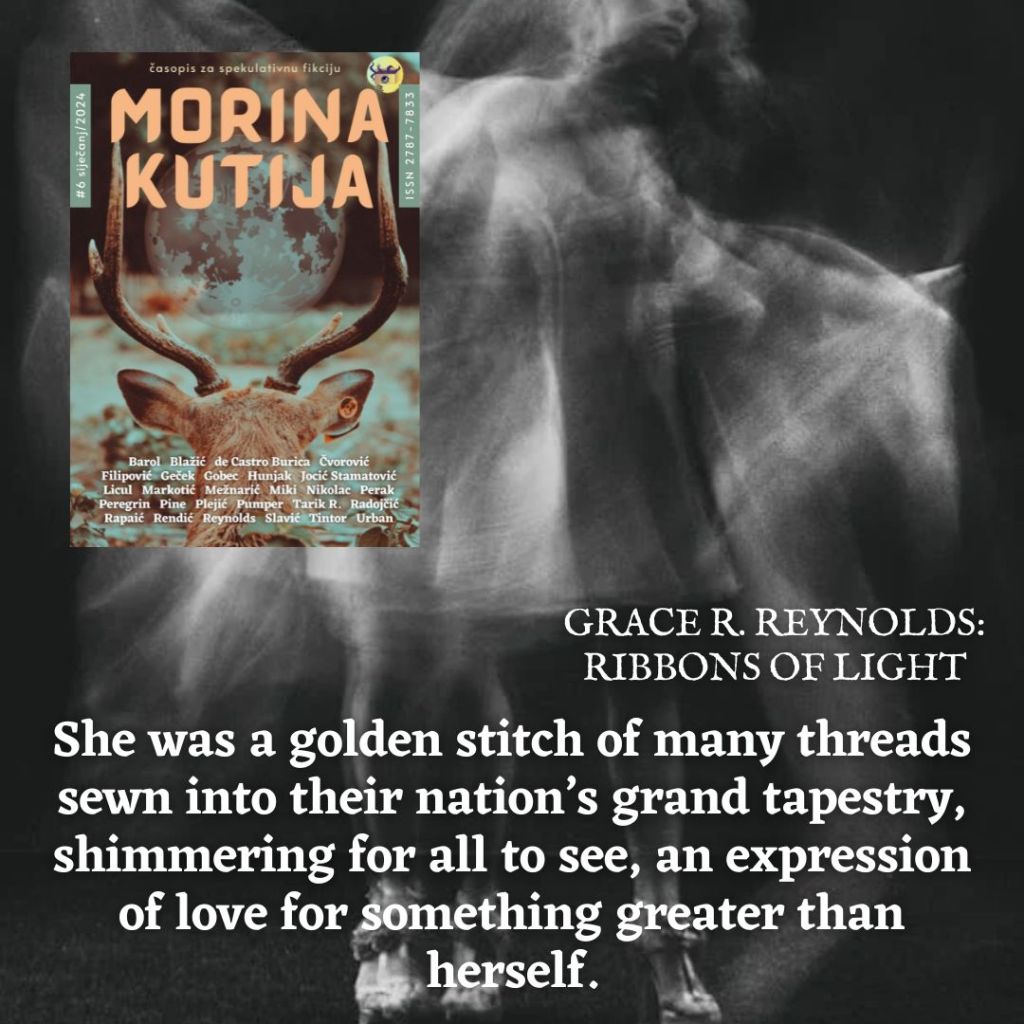
Dance connected Juliana to her culture; to her ancestors. It honored legacies left behind; a choreographed oral history that told stories of their people, rituals, and beliefs. She was a golden stitch of many threads sewn into their nation’s grand tapestry, shimmering for all to see, an expression of love for something greater than herself. Kherson is more than home to Juliana. It is her heart, pumping life through her veins.
A hush descends upon the city as carolers break away to join their families in the comfort and warmth of their homes. Juliana carves a path through the crowd, like a knife slicing through warm butter, as she spots her own home modestly standing between a pair of apartment buildings on a nearby street. Smoke billows from the chimney, and a warm glow emanates from the window facing the street. Through it, Juliana sees Mama setting the table for Christmas Eve dinner, carefully arranging the food for everyone to enjoy. Mama must have made it home early to prepare everything.
“Mama, I’m home!” she slips off her sapyansti in the threshold. Mama is busy humming Christmas songs in the dining room, eyes downcast as she straightens the place settings just right.
Juliana slips away to change, the new blouse her mother purchased for her laying flat on her bed ready to be worn. It is cream, with red and black leaves and Viburnum motifs around the collar, sleeves, and waist. Her fingertips trace the embroidery, lost in the encoded preservation of her people. Their fortitude in the face of adversity.
The front door slams shut, followed by jubilant greetings she knows of her Titka, Dyadko, and cousin Alexy. Juliana awakens from her trance, finding herself staring at her own reflection. She tucks a strand of hair behind her ear and is about to stand until she sees a familiar face standing behind her in the doorway.
“Baba?”
Juliana turns away from the mirror and sees that her grandmother is really there, standing no more than two feet away. She is, as Juliana remembers, in a modest dark blouse, her hair pleated, and wearing a gold trident pendant around her neck. While Juliana should be glad to see her, she is not, because Baba shouldn’t be here. Baba is dead.
The two are at an impasse. Neither she nor Baba utter a word or move closer to the other. A pall falls over the room between them, until Baba finally turns her head toward the hallway where Juliana’s extended family stir. She leaves the room and Juliana follows her lead to see Mama standing in the foyer. Tears well in her eyes as she hugs Titka, whose hands cup Mama’s cheeks in comfort. Why is Mama crying?
A gust of wind bursts through the door. Flecks of snow melt into Tato’s mustache as he removes his cap and coat. He smells like cloves and aftershave, and Juliana thinks she can see his aura as he stamps his boots into the mat. A halo of light radiates off his figure. Perhaps it is the ambiance of the fireplace dancing across his features, but she knows it’s something more. Something that speaks to the goodness in her father’s soul. Her heart warms to the thought of it.
Titka wraps her older brother in a silent embrace, his eyes fighting a lone tear that threatens to trickle down his cheek. “She should be here,” is all he can muster and his sister firmly clasps his hands.
“Who should be here, Tato?” Juliana asks.
Tato stills. He presses his lips, and turns toward Juliana’s direction. A chill grapevines down her arm as his eyes bore into her. He does not say a word, and Juliana is ashamed for daring to ask. Baba moves closer to Tato and Titka, her otherworldly appearance unnoticed by everyone else but Juliana. Baba watches her son and daughter hold one another in comfort and lays her spectral hand on Tato’s shoulder. Juliana always knew that Tato was close to his mother, but she had never seen him openly express his grief for her until now. A sniffle, then a swipe of his mustache, and Tato leads the family into the dining room.
Juliana rounds the corner to sit next to Tato at the table, except cousin Alexy is at the helm of her chair. She is confused, and looks at him incredulously because Alexy has never sat here before. Streams of light whip in front of her eyes and she blinks. Baba is closer now, watching her still. Juliana tries to ignore her presence and lays her hand on the chair, yet it does not pull.
As she looks down she sees Alexy is already sitting. Though it may be a slight against her person, or a bad joke between family, she writes it off as inconsequential and goes to find another seat at the table. She tries to pull back the seat beside him and realizes that it is already filled. Juliana examines the table. Every seat is filled except for one. It is then Juliana notices that this year there is one less place setting at the table.
Time ceases and the room stills. Tato is frozen in place, his hands in the middle of breaking bread as Mama expectantly reaches out to receive a morsel. He, too, has his eyes set upon the empty place setting, as does the rest of the family.
“Tato?” Juliana whispers. “Tato, what’s going on?” Silence. She tugs the corner of his vest, but still, he does not move.
“Tato, please! Say something!” Her voice quivers. A lump grows in her throat and she looks up to meet Baba’s mournful gaze. She, too, lets her wrinkled and weary eyes drift toward the empty place sitting at the table.
Tato said earlier that ‘she should be here,’ but he did not say exactly who should be here. Juliana assumed he was speaking of his late mother, but no. That wasn’t who he meant, was it? A stark realization that Tato never saw her at all, merely struck by the tenebrous cold of her voice echoing somewhere in the aether.
A flash of blue lights blinks in her mind. The crystal rain of snowflakes quietly builds a wall of ice on a cracked windshield. Colorful ribbons draped across her face. A fractured neck. Numb limbs. Mama shrieks, a police officer blocking her path. Eyes locked. Life slipping through parted lips.
Juliana’s mouth parts into an “oh” and she looks at Baba, but Baba is not long alone. Pillars of ethereal light reach toward the heavens behind her in the hundreds, maybe even thousands. They are glowing ever bright now as the world falls away, leaving only Juliana, the chair, and Baba, in its stead. Juliana’s heart pounds against the cloistered shell of her rib cage, and all she wants to do is scream, but she can’t. Why can’t she scream?
“No,” Juliana breathes. Her grandmother nods in silent affirmation and stretches out her hand, but Juliana shakes her head and staggers backward, away from her and the chair.
What would happen if Juliana were to sit in that chair? Where would she go? Would she turn into a ray of light like the others, forever shining down from the heavens on their beloved homeland?
How many times had Baba waited for her to cross over by sitting in that chair?
No. It couldn’t be true. If it was true, if she was dead, that would mean Juliana would never know the joy of hearing Tato’s heavy steps walk through their front door again. She would never remember the smell of Mama’s baking on a cold night. She would never again dance the Hopak, or any other traditional dance in those beloved red boots.
Juliana steps backward away until Baba has faded into an endless midnight sky filled with sparkling light. Only the chair remains. A silent invitation to move on to the next phase of existence, but Juliana is not ready to leave. Not yet.
Anxious, she searches for a way out of the space between life and death. She has to get back to the stage, back to the last happy memory she knows. The last Christmas Eve she would ever see. But how? Her body is growing cold now, and her face has gone numb. A steady stream of tears falls down her face and a hollow pit grows in her stomach, gnawing at her like a rat’s teeth on wood.
The chair is still standing there, waiting for her.
In her periphery, Juliana can see the lone pair of boots, standing sturdy next to the Didukhy Mama had set out earlier like a lifeline back to an endless and pleasant dream. Desperation urges her to run to them, and before she knows it the sapyansti are already on her feet, holding all of her as she tries not to fall apart.
Juliana is leaping now, her steps hammering in sixteenth notes against the membrane of a timpani, as she pirouettes onto the stage again. A composer nods, welcoming her back into the concert hall, and instructs the band below to lift their instruments to sound the opening semibreve of the Hopak. Ribbons of light dance in front of Juliana’s eyes and meet atop her crown taking the shape of her wreath as the dance troupe leap around her in flight. Juliana is weightless, spinning again, and again, in and out of formation with her fellow folk dancers. Her eyes fall upon the audience, and Mama and Tato eagerly smile back at her.
Toe—heel—lift—kick.
Toe—heel—lift—kick.
Breathe.
Just breathe.
Hands out.
Smile.
Ribbons of Light © 2024. Grace R. Reynolds
[EN] Grace R. Reynolds is a native of the great state of New Jersey, where she was first introduced to the eerie and strange thanks to local urban legends of a devil creeping through the Pine Barrens. Since then, her curiosity with things that go bump in the night bloomed into creative expression as a dark poet, horror, and thriller fiction writer. Her short fiction and poetry has been published by various presses. She is the author of two poetry collections, Lady of The House and The Lies We Weave. Connect with her on social media @spillinggrace or visit her website www.spillinggrace.com.
The story Ribbons of Light was originally published in the Morina kutija, no. 6 (siječanj, 2024). You can download it for free from our site or Smashwords.
[HR] Grace R. Reynolds je iz New Jerseya, gdje se prvi put susrela s jezivim i čudnim zahvaljujućim lokalnim urbanim legendama o vragu koji se šulja kroz Pine Barrens. Otada je njen interes za čudne zvukove u noći procvjetao u kreativno izražavanje kao mračne pjesnikinje, te horor i triler autorice. Njena kratka fikcija i poezija je objavljena kod različitih izdavača. Autorica je dvije zbirke poezije, Lady of the House i The Lies We Weave. Povežite se s njom na njenim društvenim mrežama @spillinggrace ili je posjetite na web stranici www.spillinggrace.com.
Priča Ribbons of Light objavljena je u online časopisu Morina kutija, br. 6 (siječanj, 2024.). Časopis možete skinuti ovdje ili s platforme Smashwords.
Urednički komentar: Grace nas je osvojila izrazito poetično pisanom, atmosferičnom i melankoličnom pričom o obiteljskoj ljubavi i gubitku, inspiriranom ukrajinskim folklorom.
 morina kutija
Leave a comment