
With the taste of black tea lingering on his tongue, Nick went up on the promenade deck to light his first cigarette that morning. He had half an hour before another shift in the stifling bowels of the steamship’s engine room.
A little more than a year ago, when the SS Themistocles made her first round from Liverpool to Salonica to bring reinforcements to the northern Greek front, Nick paid no attention to the land emerging from the blue.
If it wasn’t for Kostas, he would never have glimpsed through the veneer of untamed inhospitableness, beyond which every solitary rock they passed had its tale and the ancient sea they sailed still bore the mark of bronze-clad soldiers on wooden ships that traversed it thousands of years ago.
***
Last year, on the third night the Themistocles was docked in Salonica, Nick had ventured into the city for the first time. On his mate Harry’s insistence, of course. It wasn’t teeming with prostitutes like the port of Liverpool where Nick grew up, but Harry had found enough victims to play cards with.
Nick went with him to one of the tavernas along the seaside, ordered a double whiskey and elbowed his way through a drunk crowd of his rowdy countrymen who occupied the entire place. There were no free tables on the ground floor, so he took the stairs to the balcony. A few locals took refuge there and eyed Nick’s flaxen hair and pale complexion with suspicion. All four tables were taken. Nick leaned over the balustrade, lit a cigarette, and sipped the whiskey.
“My friend.”
Nick hadn’t bothered to turn at first, but then he remembered that he was the only foreigner on the balcony. He looked over his shoulder to the table closest to him, where a young man in a fine blazer of dark green wool gestured to the empty chair beside him.
“Please, sit,” he said with a smile.
“Thank you, sir,” Nick said. “I’m fine standing.”
He added a quick smile to return the courtesy and seal the matter.
“I’ll give you the table if you prefer to be alone,” the man said and stood up.
He wasn’t tall, but a slender build added to his air of elegance. His skin was much darker than that of the Greeks that Nick had seen around that night, matched with a mess of black curls and a trimmed beard. He looked more like a Turk or an Arab than a Greek.
“You’re kind, sir, but that won’t be necessary,” Nick said. “I won’t stay long. I’ll finish this drink and then I’m off to stretch my legs.”
The man tilted his head.
Nick felt uncomfortable, as if he’d said something wrong.
“You’re from the Themistoklis, aren’t you?” the man said.
Nick lifted an eyebrow. “What? Oh, you mean…yes, the Themistocles. I am.”
“I watched your ship’s arrival,” the man said. “I must admit, it was a bit disappointing to see such a small vessel named after such a great man.”
Nick was in no mood for a history lecture, but he didn’t want to be rude.
“He was one of yours, no?” Nick said. “A Greek.”
The man nodded, took his glass from the table, and walked to the balustrade with his other hand tucked in the pocket of his trousers. When he came closer to the light, Nick saw his dark eyes were circled with milky-white edges that seeped into the hazel colour of the iris.
“How do you find Thessaloniki?” the man asked.
Nick lifted an eyebrow.
“This city,” the man said. “You call it Salonica, the Greeks call it Thessaloniki. Is it much different from your cities in England?”
“It could easily pass as Liverpool,” Nick said. “It’s noisy, dirty and smells like dead rats. The houses look as if they’re about to collapse. The only thing missing are whores, thieves, and drunkards in every corner.”
Nick hadn’t expected the man to laugh.
“If that’s your verdict, then you still have much to see, my friend. There’s plenty of that to go around, but not here in the civilised parts.”
The smile never left the man’s face as he made a low bow from the neck and returned to his table. A free ticket for Nick to say goodbye to unwanted company and seek some peace elsewhere.
“I suppose you know where to find these uncivilised parts?” Nick said.
The man took a sip of his drink and placed the glass on the table, circling the rim with his index finger.
“If you’re asking me to point you to a brothel or another tavern, I could,” he said.
Nick turned and rested his back on the balustrade.
“I’m not interested in that,” he said. “Are you from here?”
“From Thessaloniki? No. But I know my way around.”
“You’re Athenian?”
Nick knew no other cities in Greece.
“Alexandrian. From Egypt.”
That would explain his looks.
“What brought you here?” Nick said.
“Work, the same as you,” the man said. “Family roots. Politics.”
Nick swirled the last of his whiskey and finished it with one gulp.
“There’s a big tower at the end of the promenade,” he said, cocking his head over the balustrade.
“Lefkos Pyrgos,” the man said with a soft nod. “The White Tower. It’s quite a sight, more so from your ship, I believe.”
“I want to see it up close,” Nick said.
The man finished his drink, never taking his eyes off Nick.
“I would be a poor host to let you go alone,” he said and stood up again. “Would you allow me to accompany you?”
Nick nodded.
The man rose and approached him. “Can I ask something of you, before we leave?”
“Yes?”
“Your name.”
A flush rose to Nick’s face.
“I’m sorry,” he said, offering a hand. “My name is Nicholas Hayes. Nick is better. Shorter.”
“Nick,” the man said as he took his hand and shook it. “Well met. I’m Konstantinos Fotiadis.”
“That’s quite a mouthful,” Nick said. “Konstantin?”
“Kostas is better.”
They spent that night sitting under the pine trees around the White Tower. Nick was just in time to catch the last boat to the Themistocles.
The next day, Kostas took him inside the city, where foreigners didn’t dare to venture. The day after that, they ate lunch in a small tavern inside a fortress perched on a hill overlooking the city.
The three weeks that the Themistocles stayed in port, Nick kept catching the last boats back to the ship.
He would wait for Kostas to finish his classes in a primary school where he taught children Greek and then roam the streets with him.
Their walks would usually end in a library stacked with dusty pillars of books.
“These eyes won’t last long,” Kostas said when Nick asked how many books he’d read in his life. “I might go blind tomorrow or in twenty years. And even if they served me until my last breath, I would still not have read all that I want.”
Kostas always had a book hidden in his pocket and a tale on the tip of his tongue. He could breathe life into the most inconspicuous object or fleeting thought, turning words into colourful threads as a skilled weaver’s fingers crafts an elaborate tapestry.
One day, a downpour of rain caught them outside the city. They hid under a ramshackled roof of an abandoned house along the dirt road. Exhausted from a second night shift in a row, Nick dozed off soon after he sat on the dusty ground next to Kostas. He woke up with his head on Kostas’ lap, covered with his dark green blazer.
Kostas asked him if he was getting bored with him talking all the time.
“I wasn’t sure how it would turn out when I first asked you to come to the White Tower with me,” Nick said. “If you’d turned out to be a bore, you wouldn’t have seen me again. I should be the one asking that question, not you.”
“You think yourself a bore?”
“I’m not the most entertaining company you could find,” Nick said. “Which makes me wonder why you keep waiting for me every day.”
Kostas laughed. “You want me to answer that?”
“I can’t wait to hear it.”
“I don’t think I have much of an answer,” he said. “I like your company. Your curiosity. Our time together has been precious to me, even if I prattle through most of it.”
“You don’t prattle. Well, sometimes.”
“And you make me laugh,” Kostas said.
“That’s to make you stop prattling, on the rare occasions that you do.”
Kostas pursed his lips. “You see? You have a kind heart. And yet, you always keep it at arm’s length. I know your name, what you do and the city you come from. There must be more than that.”
“That’s ridiculous,” Nick said. “You know plenty about me. You know how much sugar I like in my coffee and my favourite pie from Yorgos’ place. You also know the drink that you gave me last Friday makes me puke.”
“Tsipouro. It made you puke because you finished half the bottle yourself.”
“It wouldn’t have happened if it was whiskey.”
“Why won’t you tell me more about yourself, Nikos?”
What could he tell?
Of all the times he ended up beaten by the police or in prison after getting caught stealing? Or how he lied to his mother that he was going to school while he spent day and night hauling carts with cargo in the docks, only to have his father take the misery that he earned to drink and gamble it away until one day he fell drunk into the sea and drowned? How his mother went to the funeral with a shawl over her face to hide the bruises he left?
“I’d rather have you tell me what happened after Troy fell,” Nick said. “You said the story didn’t end after the Greeks took the city.”
Kostas was silent for a while. He placed his palm over Nick’s hand resting on his stomach. Nick felt his core tingle with warmth. Their fingers spread and tangled in a gentle squeeze.
“I can tell you about Odysseus’ return home,” Kostas said.
“The one who made the wooden horse?”
“Exactly. But I cannot promise you a short story. His journey was long and full of adventures.”
“Even better,” Nick said.
They returned to the city in the brief time that the rain stopped. The soaked clothes froze their bones, so they went to the nearest lodge to warm up with wine. When they finished their third bottle, Odysseus was preparing to leave the island of the sorceress Circe to find the cave leading to the Land of the Dead. After the fifth bottle, they lumbered their way to Kostas’ small apartment. Nick was too drunk to remember who of the two was the braver one to act on what their hearts and bodies desired. It was messy and too quick, then Nick soon passed out from the alcohol and hashish.
He woke up with a spinning head in the middle of the night, with Kostas looking at him. The mass of melted wax on the nightstand cast a scant glow on his naked body.
“You told me you didn’t have much of an answer,” Nick said. “To why you like my company. Was this part of your answer?”
“If I said yes, would the answer be bad?”
Kostas sat on the bed next to him. He looked away but couldn’t hide that Nick’s silence wounded him.
“You should return to the ship,” he said, turning his back to get up. “What time is it?”
Nick wrapped his arms around his waist.
“Forget about the time,” he whispered in Kostas’ ear. “Give me another bad answer.”
The last boat to the Themistocles was long gone. Nick wished he would never have to board it again.
He was confined to the ship for three days for not coming back on time, doing double shifts. The three days passed too slowly, and his senses were full of Kostas.
He could never escape the stench of grease and oil from the engine room that seeped under his skin, but his mind started conjuring the scent of sweat of Kostas’ scalp, buried under his thick curls. At night, he would curl on his bunk and grip the pillow as if it was Kostas’ flesh under his fingers.
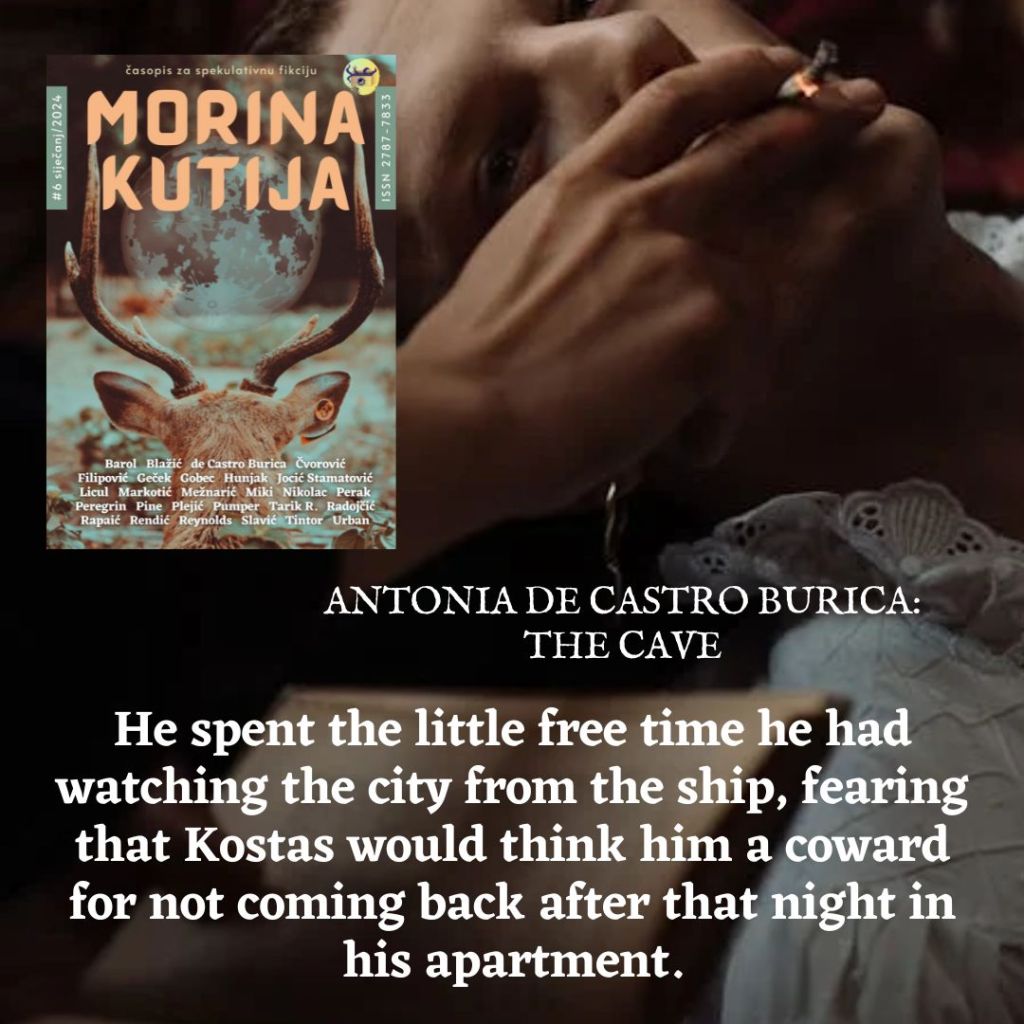
He spent the little free time he had watching the city from the ship, fearing that Kostas would think him a coward for not coming back after that night in his apartment.
Four days later, Nick found him waiting under the pine trees around the White Tower.
He promised he would wait for Nick at the same spot when the Themistocles returned to Thessaloniki next year.
***
A flock of seagulls screeched as they circled the masts of the ship. Nick leaned on the chimney funnel between two masts and reached into the inner pocket of his jacket. He took out a clothbound hardback copy of the Odyssey, Kostas’ parting gift. He never had time to finish the story of Odysseus before Nick left. Nick accepted the gift but had no heart to tell Kostas how much he struggled with reading.
He searched the marked page for the verse where he’d left off the night before.
At first, he thought that a strong wind swooped through the air, but the bellowing sound came from the depth. The entire ship shook. The sirens went off, tearing the air with an ear-splitting pitch.
Nick jumped to his feet, dropping the book. He bent over to pick it up but lost his balance as the engines came to a sudden stop. He got up on his feet and ran to the lower deck, gripping the rail of the staircase as the momentum of the ship pulled its mass in a slow turnabout.
“An explosion in the engine room!” he heard one of the crew yell through the blaring of the sirens. “Get everyone out!”
Nick sped through the corridor to reach the shaft leading down to the engine room. One of the engineers appeared from around the corner, red in his face and half-drenched in water.
“Run, boy!” he shrieked. “We’ve been hit.”
Another jolt shook the ship. The engineer fell, hitting his head on a bulkhead.
Nick managed to stay on his feet and pulled the man up to his feet.
“Hit by what?” he said. “What happened?”
“Torpedo,” the engineer said. “The engine room is flooding up.”
He pushed Nick away and went for the shaft. Three more from the engineer crew came running from the engine room.
“The Germans hit us,” one of them said and pulled Nick by his jacket, dragging him along.
“Where’s Harry?” Nick yelled. “Did he get out?”
“I haven’t seen him,” the man said. “We must abandon ship, now! Go, go!”
Nick yanked himself free from the man’s grip and ran towards the engine room. None of the fleeing men called after him.
The hull echoed with a low hum, broken by thuds and sounds of splitting metal. The lights above Nick’s head flickered on and off. He saw water filling the corridor just before he reached the door to the engine room. The door was half closed, its metal frame distorted. Inside was dark as the bowels of hell, with the sound of water pouring through cracks in the hull.
Nick called for Harry, but he couldn’t even hear his voice through the humming of the ship and the splashing of water.
The depth bellowed again. The lights went out like a wicker of a candle pressed between the thumb and the index. Silence claimed everything.
***
That bellow got stuck in Nick’s ear like a residue of memory, fragmented by muted cries and the blare of alarm sirens. A flash of light pierced through the murky veil pulled over his eyes. His eyes were glued shut, but he could see without them: a vast hall with walls of glassy black stone and a dark cloud instead of a ceiling, rumbling with a thunder hidden inside it. Another flash of lightning dispersed the vision.
The smell of burning wood crept into his nostrils. His chest ached as if his lungs were regrowing, filling a space between the ribs that had long been empty. He was lying on a hard surface, softened by layers of blankets. The pillow under his head was damp.
He could hear a faint voice. As the fog cleared from his mind, he heard a voice close to him.
His eyelids felt like old wooden shutters when he cracked them open. A woman was sitting at his left side, with loose curls of grey hair framing her face and a scarf embroidered with flowers tied around her head. She said something that sounded like a question.
Nick’s body was not his own, otherwise he would’ve jumped. The muscles tightened around his skeleton, hurting like hell.
“How do you feel?” she said in English, with an accent that Nick recognised as Greek.
Nick’s heart was in a racing contest with his breaths. He struggled to blink away the blur stuck in his eyes.
“What’s happening?” Nick said.
“Don’t be afraid,” the woman said. “My husband and I found you stranded on the beach and brought you to our home. You’re safe.”
“Ha!” A hoarse voice came from somewhere in the room. “It was you who insisted on taking him. He shouldn’t be here. Lucky for him that you saw him before the dogs. ”
The remark was followed by a dog’s whine.
Drops of sweat trickled down Nick’s brow. His mind was waking too slowly, still piecing the last memories he had from the ship.
Nick tried to stand up, but his limbs faltered. “Do you know what happened to my ship, madam?”
“What ship, young man?”
“My name is Nicholas Hayes,” he said. “I am with the British Naval Forces, deckhand on the SS Themistocles. We were hit by a German torpedo. Were there any other survivors?”
“We only found you,” the woman said.
“No one else? You don’t know what happened to my ship?”
She shook her head.
Nick wiped his palms over his face drenched with cold sweat.
“Where am I?” he said.
The woman turned to look at the man sitting on a chair by the table in a cloud of smoke, newspapers in his hands, a black cloth tied around his head and a bushy grey beard covering half his face. Three dogs were scattered around his feet, their amber eyes glowering at Nick. Their coats were shiny black, striped with thin lines of copper-orange. The one closest to the man lifted his head to look at his master.
The man took a puff from his pipe and lowered the newspapers, giving Nick a sinister glare under a pair of thick eyebrows streaked with white.
“This land is the Mani,” he said and lifted his newspapers to cover his face, as if what he said solved all of Nick’s problems.
The Mani was the second of the three peninsulas that the Themistocles was going around when she was hit. Kostas had once told him that the region was a wild place of barren mountains and warring clans.
“I need to get to some town,” Nick said, digging his elbow into the sofa for another attempt to sit up. “Are there any towns close by, or any place where I could find someone who would know what happened to my ship?”
“There’s a town up on the mountains,” the woman said. “But we rarely see anyone from there. ”
“How can I get to Thessaloniki from here?” Nick said.
“Ha!” the man exclaimed again and rose from his chair, slamming his newspapers shut on the table. Mumbling in Greek, he walked toward the door, took a cloak hanging on a pin and went out.
Nick caught a glimpse of the world outside: grey and lifeless, rumbling with the sound of an approaching storm.
“Don’t mind my husband,” the woman said with an apologetic smile. “Thessaloniki is a long way from here. A storm is on the way and the night will be very cold. What did you say your name was, young man?”
“Nicholas. You can call me Nikos. And you, kyria?”
The woman’s smile widened.
“My my, you know some Greek,” she said.
“Not much,” he said.
“It’s a good start,” she said. “I am Kori. My husband’s name Adis.”
“Thank you for taking me in, kyria Kori,” Nick said. “Though I see that your husband is not happy that I’m here. I wouldn’t want to impose on your hospitality.”
“My dear husband lacks manners sometimes,” she said. “Let him grumble. You are my guest. Rest and regain your strength.” She patted him on the shoulder and rose from the chair, straightening the folds of her wide floral dress falling to the ankles. With the corner of his eye, Nick watched her place a cast iron kettle on the stove and fill it with water from a clay jug.
The strange feeling of not belonging to his body was wearing off, but Nick’s mind was still twisting and turning the broken images of his last moment on the ship. The deep, bellowing sound that he heard on the deck must’ve been the first torpedo slicing its way through the mass of water toward the ship. The second torpedo hit the hull when Nick was in the engine room.
There was no pain in his body, just a stiff strain in his muscles, the kind he went to sleep with every time after a shift. He ran his palms over his chest and stomach. Everything seemed to be in place. No bruises or cuts. He could bend his knees and wiggle his toes. He could even sit up. The head was still a dizzy mess as he gripped the edge of the sofa, straightening his back, cracking vertebra after vertebra, feeling them fall into place as if his spine had long been out of use. He pressed his knuckles into his eyeballs to squeeze out what remained of the blurry haze.
The room he was in was small, with a table and four chairs, the stove by the sofa and a cabinet behind the table. A petroleum lamp on the table was the only source of light, creeping into the tight spaces between books messily stacked on the shelves of the cabinet. Dry herbs were tied in bundles were hung from every free space of the wall.
“How do you feel?” the woman said.
“Fine, I think,” Nick said.
“You sound as if that’s not good news.”
If the second torpedo hit the fractured hull, it would’ve mauled the lower deck to pieces, and him with it. What on earth had happened on that ship that made him wash up on the shore without a single bruise?
“I should be dead,” Nick said under his breath.
“You look alive to me,” she said, reaching for a large bundle of herbs hanging close to the stove. “Some tea, before I bring you something to eat?”
Nick’s stomach loudly complained the moment she mentioned food.
“That would be nice,” he said, forcing a smile. “Thank you.”
She opened the lid of the kettle and crushed a handful of dry leaves into the water. A strong scent of mint reached Nick’s nose.
The door flew open, letting in a thunder and Adis who carried a heap of logs in his arm. The dogs wiggled their tails when their master returned. Adis took off his wet cloak and shot Nick with a grimace as if he expected not to find him there when he returned.
Nick looked away. If he was in better shape he would’ve left, storm or no storm.
The man circled the table as his wife finished crushing the mint and slipped into another room through a curtain behind his chair. He dropped the logs into a wicker basket next to the stove and opened its door, pushing back the embers with one of the logs he brought.
Lightning flashed through the window, followed closely by a whip splitting the sky in half. A torrent of rain crashed on the roof. The storm was above them.
Adis went to the window and cracked the shutters open.
“My brother is making trouble again,” he muttered.
Nick said nothing.
“You have brothers?” Adis said without sparing Nick a look.
“No,” Nick said quietly.
He moved his head up and down, peeking through the shutters. “I have two brothers. One, always problems. The other one took something that belongs to me. Malakas, both of them.”
Bastards, he meant. Nick had heard the word quite often during his time in Thessaloniki. He wondered how that poor woman put up with a cranky old man who saw an enemy in every family member and would probably greet those brothers he mentioned by siccing his dogs on them. If any of those brothers would ever bother coming for a visit.
The man made a disgusted sound and went back to his chair, picking up his newspapers. One of the dogs nuzzled on his hand and he gave him a scratch behind the ear.
The woman disappeared behind a curtain and came back carrying a plate and something round on it. She placed the plate on the table and went to check the kettle.
“Come and sit at the table,” she said to Nick, showing the chair on the head of the table, opposite to her husband.
Nick’s legs were trembling when he stood up. The ground felt soft under his feet. He was relieved when he reached the chair without falling.
His wife brought the kettle to the table and poured the boiling tea into the mug that she placed in front of Nick. A thick cloud of minty vapour filled Nick’s nose.
“Why do you want to go to Thessaloniki?” the woman said as she circled behind her husband, brushing a hand over his shoulders before she sat at his left.
“There are English soldiers there,” Nick said. “My countrymen.”
Nick kept it curt, unsure of which side of the war his hosts were. The woman shook her head. “There’s always some war happening somewhere.”
She sounded disappointed as if this was the first time that she heard about the war that ravaged the whole continent.
Nick’s gaze fell on the plate. The round thing on it was a pomegranate, well matured, with yellow blotches spotting a coarse, red skin.
“Oh, silly me,” the woman said. “Let me get the knife so we can open it. You do like pomegranates, Nikos?”
“Yes, of course.”
She slipped behind the curtain again. There was a cupboard between the curtain and the corner of the room, with an old radio on it.
Nick stood up too quickly for what his body could take at the moment. He stumbled toward the cupboard, almost slamming into the radio.
“Does it work?” he said.
“Don’t touch that,” Aids said.
A clear warning, but Nick decided to take the risk. He was too desperate.
“Could it catch some radio station that airs news?” he said. “There might be word about my ship.”
He turned the wheels on the radio and flipped the clickers up and down. Nothing happened.
“I said it doesn’t work,” Adis said. “Get away from it, unless you know how to fix it.”
The woman emerged from the other room and went back to her chair. “Don’t bother with that, Nikos,” she said. “It was nice when it worked, to have some music in the house. Now it’s just home for spiders.”
Nick went back to his tea. He should be thankful to those people for saving his life, but their house started feeling like a cage.
The woman sliced the upper part of the pomegranate with a small knife, revealing the first juicy seeds.
Nick folded his hands around the hot mug. His eyes drifted to his watch. The pointers were going wrong. He wiped the glass with his sleeve, but he wasn’t imagining it. The short pointer was going counterclockwise very fast, and the longer one was going clockwise, skipping large portions of the circle.
Nick took it off and shook it. It didn’t help. The mechanism must’ve been damaged by seawater. It was a miracle that anything was working at all, even in such a weird fashion.
“Something wrong?” the woman said.
“My watch isn’t working,” Nick said and put it back on his wrist. “Nothing to worry about. I’ll get it fixed or buy a new one. Better losing a watch than my head.”
The woman sliced through the length of the fruit four times and cracked the parts open like a jewellery box that was hiding a hundred brilliant rubies. She left the knife on the table and continued detaching the seeds with her fingers.
“Does death frighten you?” she said.
The tea burned the tip of Nick’s tongue when he sipped it.
“If you’d asked me that question a few years ago, I would’ve had an answer,” he said. “But now…”
He let his words trickle into silence. They were all strangers to each other at that table. He wasn’t about to confess to someone he’d just met that there was a time when he saw death as the only way out of the misery he lived in, standing on the pier from which his father fell into the sea, with one end of a rope tied to the axel of his cart and its other end in his hand.
He looked up from his cup and met her dark eyes that pierced through his soul like hot needles.
“Now it’s different,” she voiced his thoughts aloud. “Something’s anchored you to this world. Or someone.”
Her words were somewhere between a question and a realisation.
The woman filled a small bowl with pomegranate seeds and slid it over the table toward Nick. He eyed it with suspicion. Maybe he was paranoid for no reason. These people were helping him, after all. But he still didn’t know what happened to the ship and his crewmates, or how he survived a torpedo blast.
Something familiar caught Nick’s attention. His jacket was hung over the chair on his left.
He cast a glance at the couple. The pipe smoke around the husband was getting thicker, rising behind the screen of newspapers. His wife didn’t seem interested in more questioning and continued unpacking the other half of the fruit.
Sliding his arm under the table, Nick pulled the jacket from the chair. It was heavier than it should’ve been. He reached into the inner pocket, took out the copy of the Odyssey and placed it on the table.
If his hosts’ story was true, he’d ended up in the sea and floated to the shore. The pages of the book were shrivelled, with the kind of crispy texture that wet paper would get after a long time of drying. The spine cracked louder than before when Nick opened it at the place where he’d stopped reading.
The papers were blank.
He went back to the pages that he’d read. All white, no traces of ink.
He jumped to his feet so suddenly that he kicked his chair behind and shook the table, knocking over the bowl of pomegranate seeds.
The seeds scattered over the white pages, soaking them in a black liquid, red at the edges.
His instincts screamed to escape as fast as he could, but his legs turned blocks of ice. Not just the legs. His skin crawled with icicles, and the blood in his veins turned thick like oil.
Their eyes were on him.
His, polished black orbs.
Hers, liquid gold.
Nick grabbed the knife from the table with trembling hands and pointed it at them.
“What’s happening?” he said. “What are you two?”
The lick of fire in the petroleum lamp fluttered and went out. Complete darkness engulfed Nick, but he could see through it.
He was back in the vast black hall with walls of glassy black stone and storm raging above. The head of a long table of polished ebony, a tall shadow rose from an enormous throne made of iron. A creature unmarred by darkness was standing at his side, with blooming flowers adorning her golden hair. She was brilliant as the sun and the moon combined, and he was a darkness deeper than the blackest of nights.
The hall echoed with his laughter, rattling Nick’s bones.
“I am King of the Underworld,” he said. “Lord of the Dead, He Who Welcomes All. I welcomed you, and yet you dare you to threaten me in my halls?”
He lifted a bony hand from the table. A monster emerged from behind the throne. It was not three dogs anymore, but one large, hideous body with three heads, bloodshot eyes and saliva dripping from their bared fangs.
She stopped his hand with a touch on his wrist.
Nick had seen enough. The door was a few feet behind him, but that was when he was in the house he woke up in. Now he had to run a long way toward the gates, with a blood-chilling howl following him.
He couldn’t recall if he pushed the doors open or if they opened for him. He kept running. The sky outside was dark—no clouds, no thunder or lightning, no stars. The ground under his feet was cold, cracked, and full of sharp stones that pierced the skin of his soles.
He stumbled and fell. His body was too heavy to stand up. He crawled, digging his elbows into the ground as he dragged his useless legs.
“Let me help you.”
Nick rolled on his back, conjuring the last ounce of strength left in him to back away as his hostess knelt by his side.
Everything about her was stunning to the senses. But above all, she was terrifying.
“I’m hallucinating,” Nick said. “You’re not real. None of this is real.”
“You are lost,” she said. “I can show you the way to where you need to be.”
“What way? How would you know where I need to be?”
“Don’t be afraid. You are my guest. No harm will come to you.”
“What…who are you?” he whispered.
Her lips curled into a smile. When she rose, her golden hair flowed down her back like a cascade of light. The flowers tucked in her locks oozed a sweet fragrance of spring.
“Come with me,” she said and walked away.
The heaviness that shackled Nick’s body seeped into the ground. He could move again.
She didn’t turn to see if he was following. As she walked down a narrow path to the shore, the ground turned lush green under her feet. As soon as she lifted her feet, it became lifeless again.
Nick gathered his wits and looked back to the place from where he’d escaped. He thought he’d run a long distance, but the small house of grey stone was not far behind. From a terrace covered with a web of twisted vines, Adis watched him with his three loyal guardians seated around him. Their house was at the foothills of a mountain so high that it escaped the darkness. Twelve gleaming white towers adorned the highest peak.
Nick followed the woman. She reached a narrow pier protruding from the rocks. A boat was tied to it, with a hunched figure seated inside.
When Nick got closer, he saw it was a man, old and grizzled, with a body that showed more bones than meat. He made no sign of that he noticed their arrival.
The woman stopped at the edge of the pier.
“This belongs to you,” she said, giving Nick the Odyssey.
Nick hesitated before he took it, careful not to touch her.
He glanced at the boat, then back at the woman.
“Is this boat for me?” he said.
She nodded and opened her palm, shoving Nick an old silver coin with worn-off edges.
“For the fare,” she said.
This time he couldn’t avoid touching her. Her skin was cold, like the air around them.
“Where will the boat take me?” Nick said.
“To where you need to be,” she said. “Someone’s been waiting for you. It’s almost time.”
The old man outstretched his hand to receive his payment before Nick stepped onto the boat. A dull cling betrayed a pocket full of coins when he slipped Nick’s silver coin inside it.
***
Except for the splashing of the old man’s oars, all was silent. No seagulls, no sound of wind. The old man hadn’t spoken a word. The water was translucent, but there were no fish or weeds below its surface. The boat made its way along the shore until it reached a swollen heap of rocks forming a promontory.
The rising sun cast a hazy light on a solitary lighthouse and a single pine tree at its tip.
The boat drew close to the shore. The old man offered no explanation for the stop. He pulled up the oars inside the boat and stuck his hand into his pocket, taking out a handful of coins. Bronze, silver, gold, big and small, they all paid for the same voyage.
Nick hesitated before he stepped on the shore, expecting that it would elicit some reaction from the old man. He was too engrossed with his coins to pay attention to his passenger.
A narrow path cut in the rock led to the lighthouse. The door of the lighthouse was sealed with a rusty chain. No one had visited it in a long time, but someone was sitting under the pine tree not far from it.
Nick walked towards the tree, passing by a heap of stones with a cross stuck on top of it. A name was once written on the cross, but the letters had already faded beyond recognition.
The figure sitting under the pine tree drew a sharp breath when Nick got closer. “What time is it?”
Nick looked at his watch. The pointers were still. “It’s 7:39.”
“You’re late. The Themistoklis should’ve docked two hours ago.”
Nick stood in front of him.
His dark curls were streaked with greys. The eyes were milky-white, with no trace of colour, and framed by deep wrinkles. He still wore the dark green blazer he loved, though the colour had turned grey, and the fabric was full of holes.
“Kostas?”
He reached with his hand toward Nick. “Sit with me for a while.”
The warmth of his touch melted the cold etched in Nick’s bones.
Kostas pulled him down next to him, smiling as his empty eyes roamed over a sunrise invisible to him.
“File mou,” he said. “I’ve missed you.”
A tear rolled down Nick’s cheek and fell on Kostas’ hand. He wrapped it up around Nick’s neck and brought their foreheads together.
“How long did you wait for me?” Nick said.
“A fragment of a moment,” he said. “Or a thousand years. I cannot tell. What matters is that you’re here.”
“I don’t know where here is.”
“This is Tainaron, the realm of Poseidon,” Kostas said. “This ground where you were buried is sacred to him. I came as a suppliant when my time approached. He took me in and allowed me to wait for you so that we might enter the cave together.”
Nick almost smiled, remembering the confusion that Kostas often embroiled him in when he spoke of old gods and ancient places.
“What cave?” he said.
“Ah, yes. It’s where we stopped, no? Odysseus leaving the island of Circe. I never got to tell you about him reaching Tainaron and the cave that leads to the Underworld.”
“I didn’t read past that verse,” Nick said. “I wanted you to tell me the rest of the story.”
Kostas lowered his head. “I’ve forgotten it.”
He must have waited so long that the words he knew by heart had faded from his memory.
“I have the book with me,” Nick said as he took out it from his pocket and placed it in Kostas’ hand. “I can read it to you, and you’ll start recalling. It’s still in there, in your memory. I’m sure.”
Kostas opened the book at the page where Nick stopped reading. It wasn’t blank anymore, but there were still traces of blood staining the paper. Nick knew it was his own. He was glad that Kostas couldn’t see it.
“Let Charon wait for us a little longer,” Kostas said. “We can steal a bit more time before he takes us to the cave. Read the verse to me, Niko mou.”
The Cave © 2024. Antonia de Castro Burica
[EN] Antonia de Castro Burica was born in 1990 in Brazil. She graduated in comparative linguistics and Portuguese language and literature. She works in digital media and as a translator from Arabic and several other languages. She’s studying Greek at the moment and hopes to add it to the list in a few years. If nothing, it will be useful for writing stories, because there hasn’t yet been one that wasn’t connected with Greece in some way or another.
The story The Cave was originally published in the Morina kutija, no. 6 (siječanj, 2024). You can download it for free from our site or Smashwords.
[HR] Antonia de Castro Burica rođena je 1990. godine u Brazilu. Diplomirala je poredbenu lingvistiku i portugalski jezik i književnost. Radi u digitalnim medijima i kao prevoditeljica s arapskog i nekoliko drugih jezika. Nada se za koju godinu u popis ubaciti grčki koji trenutno uči. Ako ništa, barem će poslužiti za pisanje priča, jer se još nije dogodilo da ijedna na neki način nije povezana s Grčkom.
Priča The Cave objavljena je u online časopisu Morina kutija, br. 6 (siječanj, 2024.). Časopis možete skinuti ovdje ili s platforme Smashwords.
Urednički komentar: Antonia de Castro Burica svojim nam specifičnim senzibilitetom i posvećenosti grčkoj povijesti i queer tematici donosi melankoličnu priču koja nas na nekoliko minuta transportira u neko drugo vrijeme, na neko drugo mjesto, u živote nekih drugih ljudi koji su nam samo naizgled poznati iz mitologije.
 morina kutija
Leave a comment