
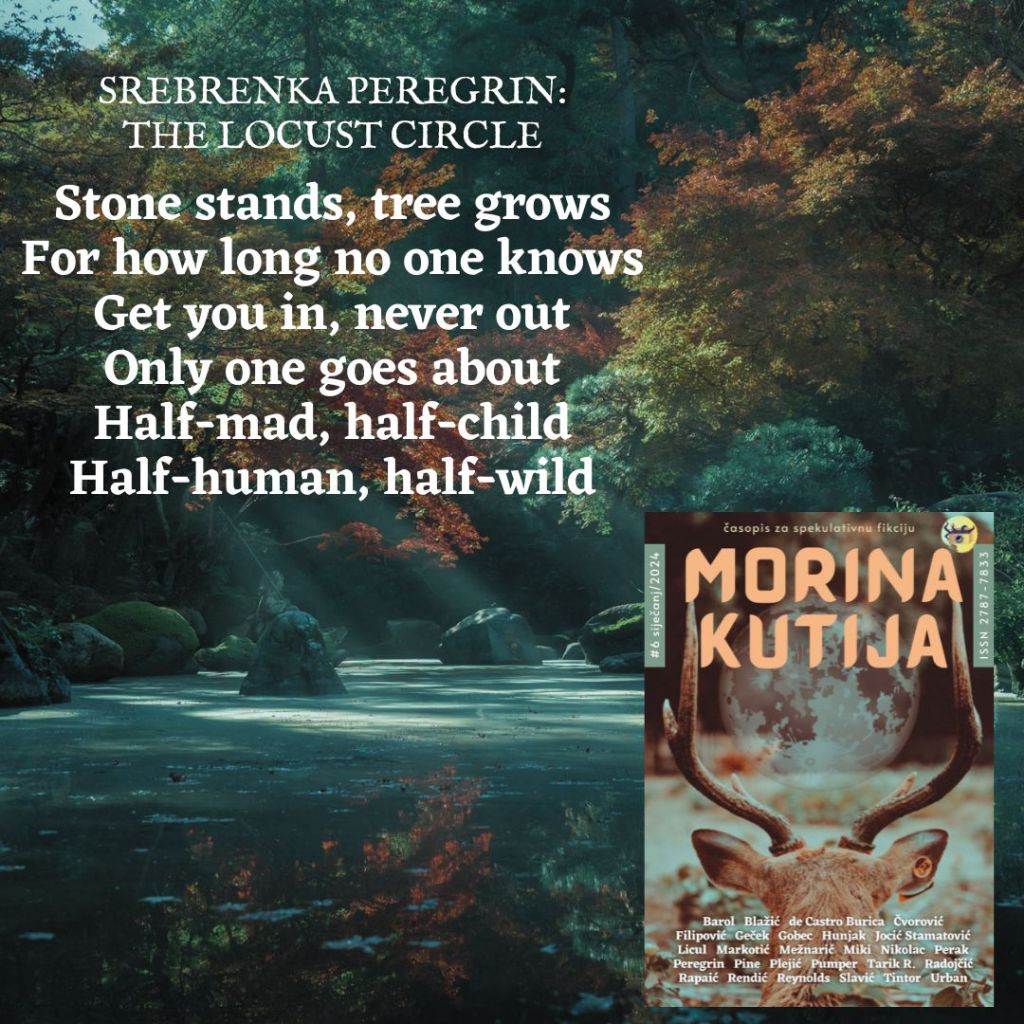
On a green knoll just outside Brimmington there was a circle of stones that bees never entered. Within it stood a grove of locust trees, fragrant in the spring. If you looked close enough, however, you would notice the stones and the grove were never mirrored in the calm pool under the knoll.
The sun, also, had a different quality among the trees—it was warmer, thicker, slower—as if riper. It was small wonder, then, that many from the town had been attracted by the smells and the light among the branches, and had wanted to get a peek. That was a long time ago, though, for whoever approached the wall did so but once. It did not matter whether one came to the circle desirous to enter it or break it. If they felt strongly about it, they were pulled in. Not one managed not to feel. Not one returned.
Each time, the wall became a little wider and the stones piled a little higher. It grew fatter and closer to the pool. The trees were taller and their flowers fuller with honey in the spring. Still, the bees did not go close, but flew around the circle and never even above it.
Standing at the pool, it was sometimes possible to see the people who had gone in, but they did not want to come out. They wandered about as if time did not pass, although first years and then centuries went by. After a while, they were not sought any longer, as those who had known them aged and died. The people taught their children to be like the bees, which would not be tricked into getting drawn inside.
Although they obeyed and did not go to the circle of stones with the grove of locust trees, the children of Brimmington made a song about it for their circle game. Children from other towns were not acquainted with it and had to be taught when they came visiting.
Stone stands, tree grows
For how long no one knows
Get you in, never out
Only one goes about
Half-mad, half-child
Half-human, half-wild
Who had showed them the game and the song, or whether they had made it up themselves, was not known. Every child in the town played it, though—even Jane, who hated the game.
“Your mum’s just like that,” other children would tell her, and chanted, “half-mad, half-child, half-human, half-wild!”
It was true Jane’s mother was a bit peculiar. The woman walked around Brimmington with a little black pig she had once saved from a hunter’s trap, though she refused to name it. She was tiny herself, so that every child secretly came to measure themselves up to her, for she was the first grown-up they surpassed in height.
They said one of her parents must have come from Faerie, but which one, they forgot. There was a grave to which Jane’s mother went, and which read Jo Smith though nobody knew if there lay a Joseph or a Joanna. They knew it was not a smith’s grave, though, because it only had a plain wooden plank marking it, instead of a stone one.
What was most peculiar about Jane’s mother, however, was that she would go to the circle of stones when the locust trees bloomed, and was never drawn in. She used to pick a single cluster of flowers that grew outside the circle and take it to the grave. This she did only once a year, but she was seen and talked about.
As soon as Jane grew up and had children of her own, she forbade them from seeing her mother. She herself would only talk to the old woman at the back door, and never took anything she brought as a gift.
“She cannot be clean if she keeps that pig with her all the time,” Jane would tell her husband. “Who knows what diseases she could pass the children, or how foul her pies are.”
And he nodded, because everybody in Brimmington knew about Jane’s mother, and even he hardly greeted her in the street. But he secretly took the pies from the waste pile and ate them at night, when Jane did not see. There could be much dirt thrown at Jane’s mother, but she could cook. Everybody granted her that.
If there was anyone at her door, they came to buy one of her pickles—mushrooms, and peppers, and onions, and lady fingers—or to smell the bread she was making, for she also did wonders with dough. However, the most prized of all was her candied fruit. They never knew where she found such perfect cherries, as there were none in her garden; and neither were there roses, or oranges, or ginger root.
And yet, Jane’s mother made all these, with sugar or honey, in modest quantities. She sometimes sold them but more often she left them out for children who came to lurk around her house and measure how tall they had grown over the summer. As children will, so these could eat plenty sweets more than they were offered.
When they reached the bottom of the jar, they nudged the youngest one among them, “Go and ask the old lady for some more.”
“Why me?” the child asked, mouth sticky with sugar and hair bobbing around in locks.
“Because she’s your grandmum, Jess, you silly sod,” they said.
Jess did not know this, and so obeyed out of sheer surprise to find out she had a grandmother. The child knocked on the door, and said good morning, and could we, and please. And Jane’s mother, who was indeed her grandmother, was unable to refuse.
After that day, Jess came often and got a sweet each time. It was not long before she began to tag Jane’s mother and her pig and would not stop even after she got a beating or two when Jane found out. Grandma sometimes shooed her away herself, but oftentimes did not, and the pig just oinked.
Jess, who followed her anywhere after a time, once saw the old woman go down an unused path. In two shakes, the child was on her track, and it was not long before they arrived at the circle of stones. There the old woman said—
Stone stands, tree grows
For how long no one knows
Get you in, never out
Only one goes about
—or something so similar it sounded the same. Hearing the familiar words, Jess ran straight to her, clapped her chubby hands, and sang along.
Half-mad, half-child
Half-human, half-wild
Jane’s mother stretched out her hands to catch Jess, and none too soon. For the stones melted, or perhaps they widened, and there was a path straight into the circle, or meandering in and out. The pig scampered away as fast as it could, but the little girl would have gone in if it had not been for her grandmother.
The old woman held Jess tight in her arms and ran in the opposite direction, following the pig’s trail. At first, Jess cried, screamed, and flailed her arms. But the further away they went, the less energetic she was until, just outside Brimmington, she went quiet and limp.
The old woman looked at the child and saw that her mouth was open though she could not utter a sound; her eyes looked but did not see; her ears listened but did not hear—and Jane’s mother knew her soul had gone into the locust circle. She knocked on her daughter’s door and placed Jess in the father’s arms.
“I am sorry,” she said, but what she really meant was that she could not have prevented it even if she had tried, and that sometimes things happened which, no matter how hard, are more difficult to reverse than to bear.
Jane’s husband was about to say something when Jane appeared at the door. Quickly gathering what had occurred, she had a fit and sent him inside. Then she yelled and screeched, cried and cursed, until she drove her mother away. Her husband put Jess to bed and then came back for Jane. He gave his wife a drink and two and three, and, when Jane was asleep, he went to Jane’s mother on his own.
“It is like this,” he said, sitting in her kitchen, eating a cake crust. “Jess is our youngest and, Jane swore the day she was born, our last. My Jane may have her favorites in one of the older and more obedient ones, but I am really fond of Jess. Do you think you could make her better?”
“I could try,” Jane’s mother said and passed him some jam.
“If you can do that, I promise I will never again let Jane keep you away from Jess, or any of your grandchildren,” he said dipping a spoon into the jar, “no matter how she might abuse or deprive me.”
Jane’s mother patted his hand and early next morning, while the moon was still up but the sun not just yet, she went to the circle of locust trees. There she picked a cluster of flowers that hung over the stones and prepared from them a fry, dripping with sugary syrup.
With this she went to the cemetery and sat on the grave marked by the wooden board. The pig lay down and put its snout on her leg. The woman knocked on the plank and waited, neither eating nor drinking anything herself, until the sun had set but the moon had not yet risen. Then, in the starlight, there came a shadow and sat next to the pig. It ate the sweetmeat and licked her fingers.
“I never get tired of these,” the shadow said. “They grow so well there.”
“I need your help,” Jane’s mother said. “They took the little one’s soul.”
It took almost entire night to persuade the shadow. It was unwise, the shadow said. It was also dangerous. She herself did not know how it was done. There would be retribution, she added. To each, Jane’s mother had a reply. And she finally admonished, “Jess is of your blood, mother.”
“Ah, very well,” the shadow said, “but they will not let us get away with this, you know, unless you defeat them for good.”
“I know,” the old woman told the even older shadow.
As Jane’s mother rose to leave, the shadow blew a cold breath into her eyes. Immediately, there stretched before the old woman a shiny path which led away from the cemetery and towards the pool. She said goodbye and stepped onto it.
It slithered across the fields and wound through a thicket, but the old woman never strayed. The little pig followed happily. Finally, they reached an arch through which they passed, just as the moon was over the calm pool. In its light, the old woman saw a figure that might have been a man in a long coat and large boots, rustling through the reeds.
“Hello, father,” she said.
He stopped his work, embraced her, and asked, “Has your mother sent you, then?”
Jane’s mother nodded and accepted the invitation to sit down near the pool. While the pig sloshed and nibbled on the greenery, her father listened with his hands under his chin. Then he said he could not really help, and there was a long discussion at the end of which Jane’s mother said, “You got mother’s soul out.”
“But they kept her body,” he said. Then, seeing the old woman would not be dissuaded, he asked, “Do you still remember the last line of the song?”
Jane’s mother said, “Fair water, fair bone, fair dust sunder stone.”
“Here is the water,” he said and cupped some of the pool water in his hands. “You must keep it in your mouth until you get the container for it. You can neither spit nor swallow it, or it will not work.”
Then he knocked his boots against her feet and under them appeared a winding staircase that led into the mountains. She climbed it, and climbed it some more, until she was at the top, and then over, and entered Faerie. But the pig, which had climbed with her, stopped at the summit, and would go no further.
Because no one can enter Faerie in secret, she was immediately surrounded by the fair folk and taken to their King and Queen. They asked many questions, but she only gestured she could not speak. Therefore, they sent her to work in the kitchens, for that is the destiny of people who come to Faerie. They are nothing more than servants, until they grow tired of it and wish for their own life back. Sometimes they even get their wish fulfilled.
But Jane’s mother did not tire quickly. She stayed, and she worked, and when the need arose, she prepared a most wonderful cake. She baked into it all her longing and her desires, all her hopes and secrets. When the King and Queen tasted it, they were awestruck and ordered the one who had made the cake be brought before them.
Then they asked what she wanted as a reward, offering her riches, youth, and health. Jane’s mother shook her head in refusal. Bowing low, she pointed to the dust that had settled about the Queen’s delicate feet, the dust of offerings brought before them for centuries.
“You choose wisely, old one,” the King said.
“Use it wisely as well,” the Queen said and scooped the dust from under her feet.
She poured this into the ears of the old woman and waved her away. Then Jane’s mother bowed again and looked under her own skirt to find the beginning of the stairs by which to descend from Faerie. Over and across she went, finding again the little black pig, which waited devoutly. Then down and further down they went, until they arrived at the knoll with the circle of stones in which locust trees grew.
For the first time in her life, the old woman desired to enter the circle, and the stones obeyed. They melted, or they might have widened, and there was a path which led straight inside, or perhaps meandered in and out. She took it, and the little pig followed this time. Quickly they found themselves under the locust trees, and the stones clasped back behind them.
Jane’s mother turned this way and that, trying to discern whither she ought to go. But she could not see anyone or anything, because a dense fog had descended within the circle. In the fog, there might have been people, or their souls, or shadows, or nothing at all except whiffs of smoke.
She followed the pig, which ran into the fog unfearingly, but how long they wandered so, Jane’s mother could not tell. Because time walks at a different pace inside the circle, it sometimes seemed to her days and nights passed, while at other times barely a moment or two.
After a while, or longer, she felt tired, and her old feet slowed their trudge. She could not keep up with the little black pig any longer, but sank under one of the trees, unsure if she would be able to rise again.
Whether she had slept or not, she could not say, but when she opened her eyes, the pig was there again, wagging its tail, with a muddy snout. Not far away, the soil was dug up and the old woman stood up to see. Bones were sticking out of the ground, and she began to dig, with her own nails and hands, until she discovered a smooth and round container buried under the moss and the roots.
When it was finally unearthed, she cleaned it with freshly picked grass, spit the water from her mouth into it and said, “Finally we meet, mother.”
Then she poured the dust out of her ears into the skull, too, and mixed thoroughly.
“Find the stones,” she told the little black pig, and it cocked its head and dashed into the fog.
Jane’s mother followed it. When they reached the wall, she wetted her fingers with pool water and fairy dust from her mother’s skull, and sprinkled the stones. Almost at once, they began to sizzle and crack. They undulated and crumbled. Finally, they fell to the ground, so that there was barely a single stone left on top of another.
It was but a short way to go round, now that she followed the wall, and soon enough all the stones were toppled. Then some of the locust trees withered and fell where they stood, and the people who were inside met up with time again as well. Those who had been inside for long, withered on the spot and dropped down in a heap of bones. Others got out already ancient and died of grief when they found out how much time had passed. Some lived, however, and descended the knoll to go away in search of their destinies.
Jane’s mother was among the latter and, feeling a sweet wind in her hair, she hurried to her daughter’s house. There she found that Jess had risen from bed and had already gone off to play.
Jane’s husband embraced the old woman and asked, “How can we be of help?”
And the old woman showed them the many stones that were now scattered about the knoll after the circle had been undone. Then Jane and her husband, and many other people from Brimmington, took those stones away and used them as they best could.
They made a proper staircase up the mountain and into Faerie, so that whoever was in need could go and ask for help. Other stones were laid down to make a walking path and a small pier at the calm pool. And with the remains they built a proper grave for Jane’s grandmother, her skull and bones now in their rightful place.
Jane’s mother was found sitting there one morning, with a wooden smile on her face, and her eyes as still as pool water. They laid her next to Jo Smith and wrote Jude Smith on the stone slab. The little black pig they gave to Jess to play with.
Fair water, fair bone, fair dust sunder stone—is all the children sing these days.
The Locust Circle © 2024. Srebrenka Peregrin
[EN] Srebrenka Peregrin writes short stories in Croatian and English, translates, and tells fairy tales and folk stories. With her friend and fellow storyteller Erika she collected and published a trilogy of collections featuring stories from all over the world: Bajkarice, Bajkari, and Bajkarenje. She’s also the author of the adult fantasy novel series about Frina the courtesan. She works and lives in Zagreb along with a two-legged teen and several adopted four-legged family members.
The story The Locust Circle was originally published in the Morina kutija, no. 6 (siječanj, 2024). You can download it for free from our site or Smashwords.
[HR] Srebrenka Peregrin piše kratke priče na hrvatskom i engleskom jeziku, prevodi, te pripovijeda narodne bajke i priče. S prijateljicom pripovjedačicom Erikom skupila je trilogiju priča iz cijelog svijeta: Bajkarice, Bajkari i Bajkarenje. Za odrasle piše fantasy krimi-romane o Frini, kurtizani u usponu. S tinejdžerom dvonošcem i udomljenim četveronošcima živi i radi u Zagrebu.
Priča The Locust Circle objavljena je u online časopisu Morina kutija, br. 6 (siječanj, 2024.). Časopis možete skinuti ovdje ili s platforme Smashwords.
Urednički komentar: U vrijeme dok se svi razbacujemo pojmom “fae”, Srebrenka nas podsjeća na one vile na koje nas narodne priče upozoravaju da im ne smijemo vjerovati kad napuštamo selo. Ovaj odličan suvremeni folk fantasy, savršen je za fanove bajkovitih priča T. Kingfisher.


 morina kutija
Leave a reply to Antonija Meznaric Cancel reply